
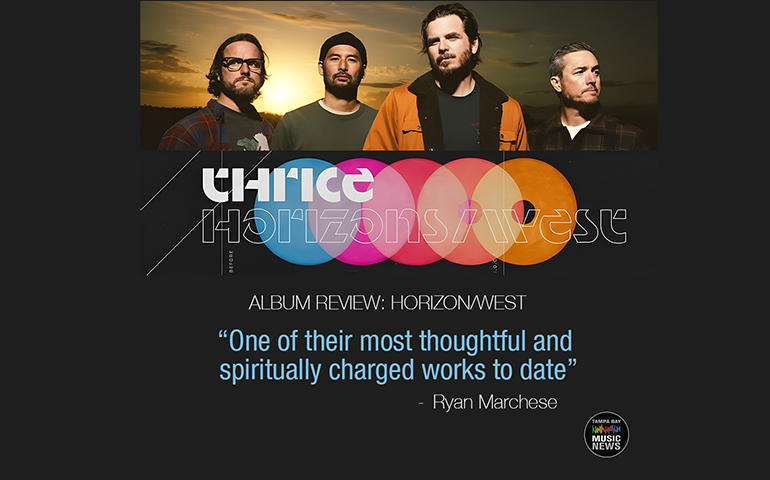
Review by Ryan Marchese
There’s a haunting beauty in Horizons/West, something that feels both familiar and foreign, like catching the scent of a memory you can’t quite place. It’s fitting that this is the first time in Thrice’s 27-year journey they’ve created a sequel album. As the counterpart to 2021’s Horizons/East, this record feels less like a continuation and more like a reflection, the other side of the same mirror. It doesn’t just move forward in sound; it deepens in spirit. From the very first notes, there’s a quiet confidence in how it unfolds. Thrice isn’t chasing nostalgia or relevance; they’re peeling back layers, asking harder questions, and finding grace in restraint. The patience, the honesty, the way these songs unfold with such intention. The album doesn’t demand your attention; it earns it, slowly revealing itself as one of their most thoughtful and spiritually charged works to date.
What makes Horizons/West so affecting is how it wrestles with the unease of our modern world. Frontman Dustin Kensrue has said, “We’re constantly being influenced by algorithms, by fear, by our own social echo chambers. Horizons/West tries to pull the curtain back on some of that.” That tension between the self and the noise, between perception and reality, is the pulse that drives the record. Kensrue’s lyrics circle around the fragility of truth and the quiet ache of living in a world that constantly distorts what we see and feel. It’s not just an album about finding clarity; it’s about surviving the blur. Listening to it, I found myself thinking about how much of my life, my thoughts, my emotions, are shaped by things I can’t even see. It’s unsettling, but Thrice somehow makes that confrontation feel hopeful, as if they’re saying, “You’re not alone in this confusion. We see it too.”
“Blackout” is the perfect opening track; it immediately sets that tone of rediscovery. The reimagined melody from “The Color of the Sky” feels like a memory being rewritten in real time. Then Dustin’s voice enters, rough-edged, human, alive, and I felt this familiar jolt in my chest, the same one I’ve felt hearing Thrice for decades. As the song builds, it starts to feel like a storm you don’t want to escape from. The driving beat of the drums, swirling guitars, layers of sound that feel like they’re swallowing you whole. And then it shifts, transforms, and in that moment, I thought, This is why I love this band. It’s one of those songs I can already imagine screaming along to, surrounded by people who feel it the same way.
The album’s emotional weight crescendos with “Gnash” and “Albatross,” two songs that stand as opposite poles of Thrice’s sonic spectrum. “Gnash” is primal and punishing, easily one of the heaviest things they’ve done in years, evoking flashes of The Artist in the Ambulance while diving headfirst into existential dread. Lines like “I’m every fear that steals your sleep / And each precious thing that you can’t keep” hit with the blunt force of recognition, a reminder that our demons often wear our own faces.
“Albatross,” on the other hand, feels like a deep breath after the storm. It’s lighter, melodic, even romantic, but still threaded with melancholy. Each verse and chorus push and pull like the tide. The interplay between Dustin’s vocals and the instrumentation feels intimate, almost fragile. When he sings, “They keep on telling me our stars are crossed / But I think that you might be my albatross,” it lands like a confession, both romantic and devastating. It’s such a perfect encapsulation of love that carries weight, beautiful but burdensome. I could feel that lyric settle somewhere deep, where nostalgia and ache coexist.
“The Dark Glow” is another highlight, shimmering with the kind of emotional depth that Thrice has mastered over the years. The lyrics read like poetry: “We all know / We hold our breath / The wind blows / Until there’s nothing left…” and the melody clings to you long after the song fades. It carries echoes of To Be Everywhere Is to Be Nowhere, not as imitation but as evolution, a continuation of that same restless search for meaning amid the chaos. I felt that same mixture of sorrow and gratitude, the kind that only comes when a song says something you didn’t know you needed to hear.
Throughout Horizons/West, Thrice’s signature dynamic mastery is on full display. Delicate, introspective verses build into crashing waves of sound and emotion. The album doesn’t reach for the obvious; it rewards patience, leaning into texture and tension rather than sheer force. The quiet parts linger longer, the heavy parts hit deeper. Every note feels intentional, every silence earned. The production breathes; you can hear the space between the instruments, the humanity in every imperfection. The more time you spend with this record, the more it reveals. The more I listened, the more I found myself sinking into the textures, noticing new layers, and feeling new emotions rise to the surface. This is an album that grows with you.
Horizons/West isn’t just a follow-up to Horizons/East; it’s a mirror held up to it and to us. It’s an album that meets you where you are, offering stillness in a world that never stops shouting. It might not roar with the same urgency as their early work, but it hums with a quieter kind of power, one born of reflection, resilience, and grace.
If you’ve grown alongside Thrice, this record feels like coming home, not to who you were, but to who you’ve become.