
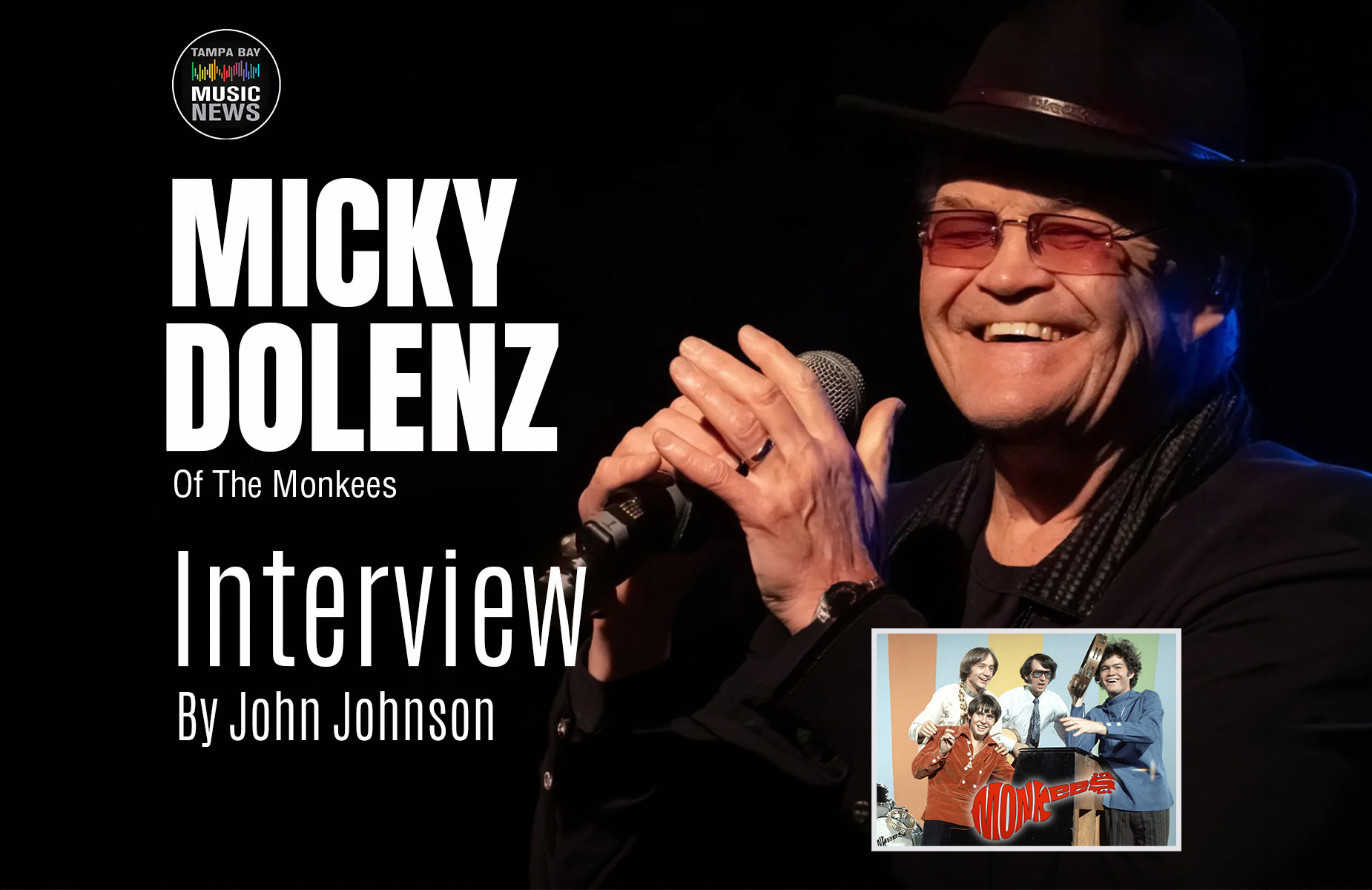
By John Johnson
[ June 28th- Micky Dolenz | Nancy and David Bilheimer Capitol Theatre]
Tickets here
There are certain interviews that come with a little extra pressure. This was one of them. Being of a certain age and growing up on television sitcoms of the late 60’s and all of the 70’s, where wacky shows were ingrained in our psyche. They still have a place in our hearts and minds, and The Monkees was most assuredly one of those shows for me. So when given the opportunity to speak with none other than the LAST Monkee, I jumped at the chance.
Coincidentally, he was also my favorite Monkee. He was the funniest, certainly the wackiest and to top it off he was the drummer. When I was really young, I wanted to be a drummer and that was actually the very first thing I mentioned to Micky when I answered his call. I confided that there were two guys that made me want to thrash on a drum kit, Micky Dolenz and Bingo from the Banana Splits. To hear Micky Dolenz burst with laughter out of the gate, gave me such a thrill. He followed it with “That’s right!”, and we were off on what would be a very quick 20 minutes and 48 seconds.
I promised myself I wouldn’t geek out too much. No promises were made about succeeding. But I also knew that with limited time, I didn’t want to ask the run-of-the-mill questions. Even though I would have loved to discuss him being the owner of the first commercially available Moog synth, or the fact that Jimi Hendrix opened for The Monkees. Both topics I would love to spend hours chatting about, but alas, time was short.
When he called in, he was relaxing at his summer home in Pennsylvania with his wife. I asked how he was doing, he delivered the kind of perfectly Micky Dolenz answer you’d expect. “I’m above ground.” That’s a pretty solid place to start.
As we chatted, I mentioned that my wife had reminded me that exactly 15 years to the day (6/4/2011), we’d seen The Monkees perform at Ruth Eckerd Hall. The show had three of the four performing together, Micky, Peter Tork and Davy Jones. Micky remembered playing there many times. I recall my wife pointing out that I was wearing the same shirt Davy Jones was wearing. Which caused Micky to laugh aloud again, I was on a roll apparently.
One of the first mysteries I needed solved though, involved the famous casting call that referenced “Ben Frank’s types.” Famously, there was an advert that read “MADNESS! Auditions. Folk & Roll Musicians-Singers for acting roles in new TV series. Running parts for 4 insane boys, age 17-21. Want spirited Ben Frank’s types. Have courage to work”. I had known of the ad but was never quite clear on what Ben Frank’s was. Turns out Ben Frank’s was a legendary Sunset Boulevard coffee shop where the long-haired musicians, artists, and Laurel Canyon crowd gathered in the 1960s.
Micky immediately knew where I was headed. “Ben Frank’s was a coffee shop. Diner… just a regular place on Sunset Boulevard,” he explained. But it wasn’t just any coffee shop. “It became a local hang,” he said. “One of the places where the long-haired weirdos and bell bottoms would hang out.” Micky laughed as he described the crowd that gathered there during the mid-1960s. “It became a hang for that generation—my generation. Specifically in the Sunset Boulevard, Laurel Canyon, long-hair, folk music, folk-rock music kind of world.”
In other words, if you were young, creative, musical, and maybe a little unconventional, Ben Frank’s was your place. “It was the equivalent of the place in American Graffiti or Happy Days,” he said, “but it was the ’60s.” Suddenly, that mysterious casting-call phrase made perfect sense to me. The producers weren’t just looking for musicians. They were looking for personalities who embodied a particular culture and moment in time. I couldn’t help thinking how awesome it would have been to hang out there. But I lived on the East Coast and was 4, so…
When the conversation shifted to the legendary Monkees auditions, Micky slipped effortlessly into storyteller mode, which the spry 81 year old excels at. “I was in college at the time, studying to be an architect,” he recalled. Most people forget that before becoming America’s favorite television drummer (along with Bingo), Dolenz was seriously considering a completely different future. “I had been an actor since I was a kid,” he said, “but I was studying to be an architect.” Yes, he was a child actor WAY before the Monkees, Google “Circus Boy” but make sure you specify Micky Dolenz or there’s no telling what you might get.
Then came the audition that changed everything. Micky remembered Davy Jones being “kind of a shoo-in because he was so cute,” while Mike Nesmith had arrived from Texas after seeing the now-famous casting notice. The best audition story, however, involved Peter Tork. “There were two guys that came out from New York from the Village,” Micky said. “One of them saw the ad and went to the audition. He did not make it, but he told his roommate, his friend, whose name was Peter Tork.” Peter got the role. As we all know. The roommate who didn’t?
“His friend was named Stephen Stills.” Micky paused for effect. “But it’s okay. I wouldn’t worry about it. Stephen’s done okay.” I think it’s safe to say things worked out for everybody involved.
Of course, with every major music act seemingly getting a biopic these days, I had to ask if there was ever talk of a Monkees movie (other than that mediocre Daydream Believers from 2000)
“There is always somebody talking about a biopic,” he laughed. The challenge, as Micky explained, is that the four Monkees never actually owned the Monkees name or brand. I wasn’t completely surprised at this as there are so many horror stories about artists getting screwed by the “industry”. “We were hired hands. We have no rights to the name, the logo, nothing.” He stated that Rhino Records controls all things Monkees and “it’s in their hands and have been doing a wonderful job, keeping the monkees thing going.”
Still, he hinted that there are always projects floating around. I was super curious to find out who he, a guy that’s been in the entertainment world for 70 years, who should play him in a movie, he didn’t hesitate.
“I was thinking maybe Taylor Swift.” We both laughed, even though he was probably only half kidding. Honestly? That’s casting I didn’t see coming but I dove in and suggested that she’d probably “do well with an afro wig sitting behind a kit”. Belly laugh number three from Micky Dolenz.
One of the things I’ve always enjoyed most about Micky’s live appearances, as mentioned, is his storytelling. His Songs and Stories performances feel less like concerts and more like spending an evening with a chum, one who just happens to have crossed paths with half of rock-and-roll history.
That history, strangely includes Head, the wildly experimental Monkees film that has become a cult favorite over the years. Being an Indie film guy and aware that it was co-written by Jack Nicholson, I had to get his take. “It’s a strange little film,” Micky admitted, “but it’s definitely got a cult following.” I agreed, it’s not for everyone. “Indeed” he chuckled.
He also reflected on one of the biggest surprises of his career: making it to a 60th anniversary tour. I wondered if he could believe that it’s been 60 years. “No. Oh boy, what a trip. What a schlep.” After six decades, he still sounds amazed by the journey. When the conversation turned to famous encounters, I asked if anyone had ever left him starstruck. The answer came immediately. “That would have been The Beatles.” Micky spoke warmly about how The Beatles understood what The Monkees actually were. “John Lennon once said The Monkees are like the Marx Brothers.” According to Micky, Lennon was exactly right. “The Monkees were not a band in the traditional sense. It was a television show. A musical comedy sitcom about this band.” That distinction, he believes, is why some critics never quite understood the phenomenon. The Beatles did.
Then came one of my favorite stories of the interview, the moment Micky realized The Monkees had become something much bigger than a TV show. During Christmas of 1966, after several months of filming, he headed to the same shopping mall he’d visited his entire life. The show had been on the air for only a few months. As he walked through the doors, chaos erupted. “All these people are running at me, screaming.” At first, he thought there was an emergency. “I thought it was a fire.”
Instead, they had recognized him. Every kid in the mall suddenly knew exactly who Micky Dolenz was. Ironically, his biggest complaint wasn’t the fame. “I was kind of pissed off because I couldn’t go shopping.” His assistant ended up finishing his Christmas list. As he told the story, you could almost hear the disbelief that still lingers decades later. “That’s kind of the first time that I realized, ‘Oh, this could be the start of something” he said with an air of pride and maybe a dash of melancholy.
Being a big fan of music and the history as it relates to pop culture, I was aware of the old misconception that The Monkees couldn’t play their own instruments. But I still wanted to hear his take. I mean, I literally have a Monkee on the phone, so I asked. And he sternly replied, “You had to be able to sing and play an instrument to get cast into the show.”
In fact, his audition piece was Chuck Berry’s “Johnny B. Goode” on guitar. He explained that the producers always seemed to have live performances in mind if the show succeeded. When the time finally came to tour, he worked relentlessly to improve his drumming. And then he shared what may be the perfect description of The Monkees’ transformation from television, almost cartoon like characters into a real performing pop rock band. Mike Nesmith once said it was “like Pinocchio becoming a real little boy.”
You can’t improve on that.
Before wrapping up, Micky offered one final insight that completely changed how I viewed the show that surprisingly snuck passed me. Unlike A Hard Day’s Night, where The Beatles were already famous, The Monkees TV series was about a struggling band trying to become successful. “On the Monkees TV show, we never made it.” he exclaimed.
Every episode revolved around “chasing gigs, finding managers, and trying to break through.”
“It was about this band that wanted to be The Beatles.” Of course, being broke-ass musicians, they somehow managed to afford a Malibu beach house the entire time. “That’s Hollywood.” he laughed.
As our time came to an end, I thanked him for the music, the memories, and the countless hours of entertainment he’s provided generations of fans. Present company included.
After spending 20 minutes (and 48 seconds) with him, I came away with the same impression I’ve always had: Micky Dolenz remains exactly what audiences have loved for 60 years—funny, thoughtful, self-aware, and endlessly entertaining. He also has that infectious laugh that I consider myself blessed to have gotten out of him (at least 4 instances) in our short time together.
He brings his 60 Years of The Monkees Tour to the magnificent Nancy and David Bilheimer Capital Theater on June 28 in beautiful downtown Clearwater. The show is sure to be filled with memorable tunes, laughter inducing storytelling, a tight backup band and of course his lovely talented sister Coco. And yes, if a Monkees biopic ever happens, I fully expect Taylor Swift to be at the top of the casting list. I mean, come on, who wouldn’t want to be Micky Dolenz? I STILL do.
Now. Go Out and See, Hear and Feel Live Music.